- Details
- Written by: Will Renwick
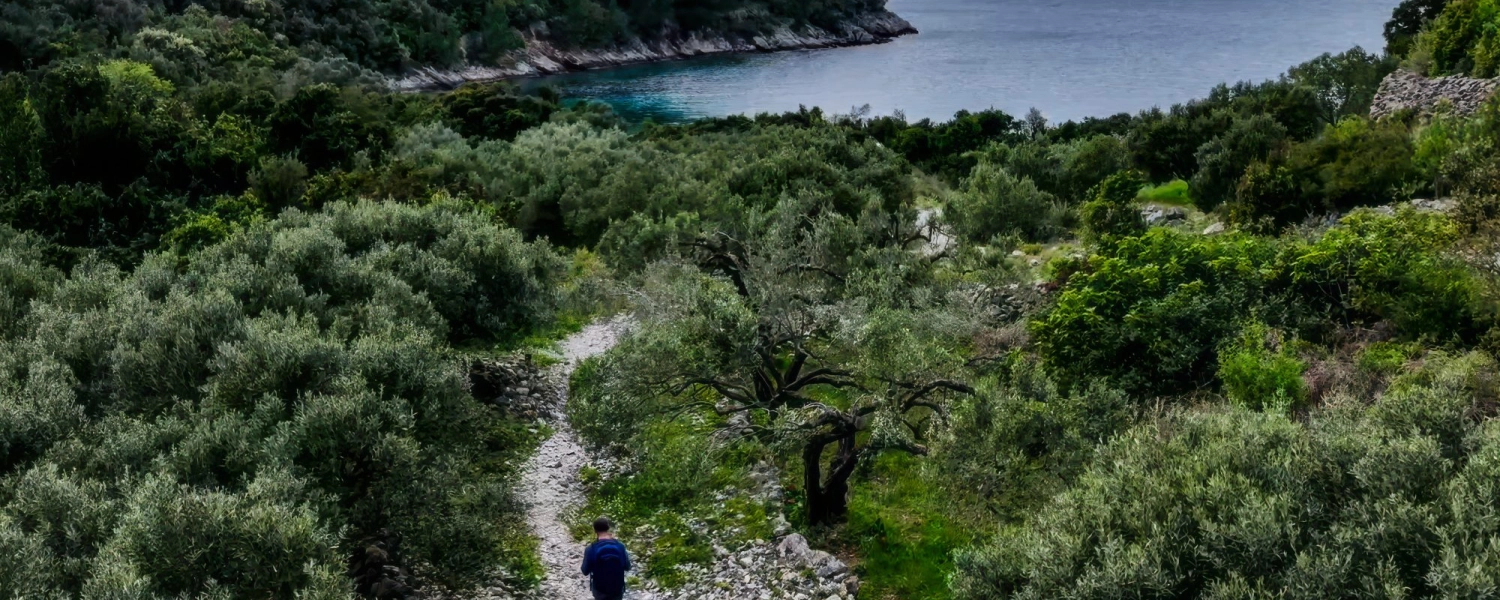
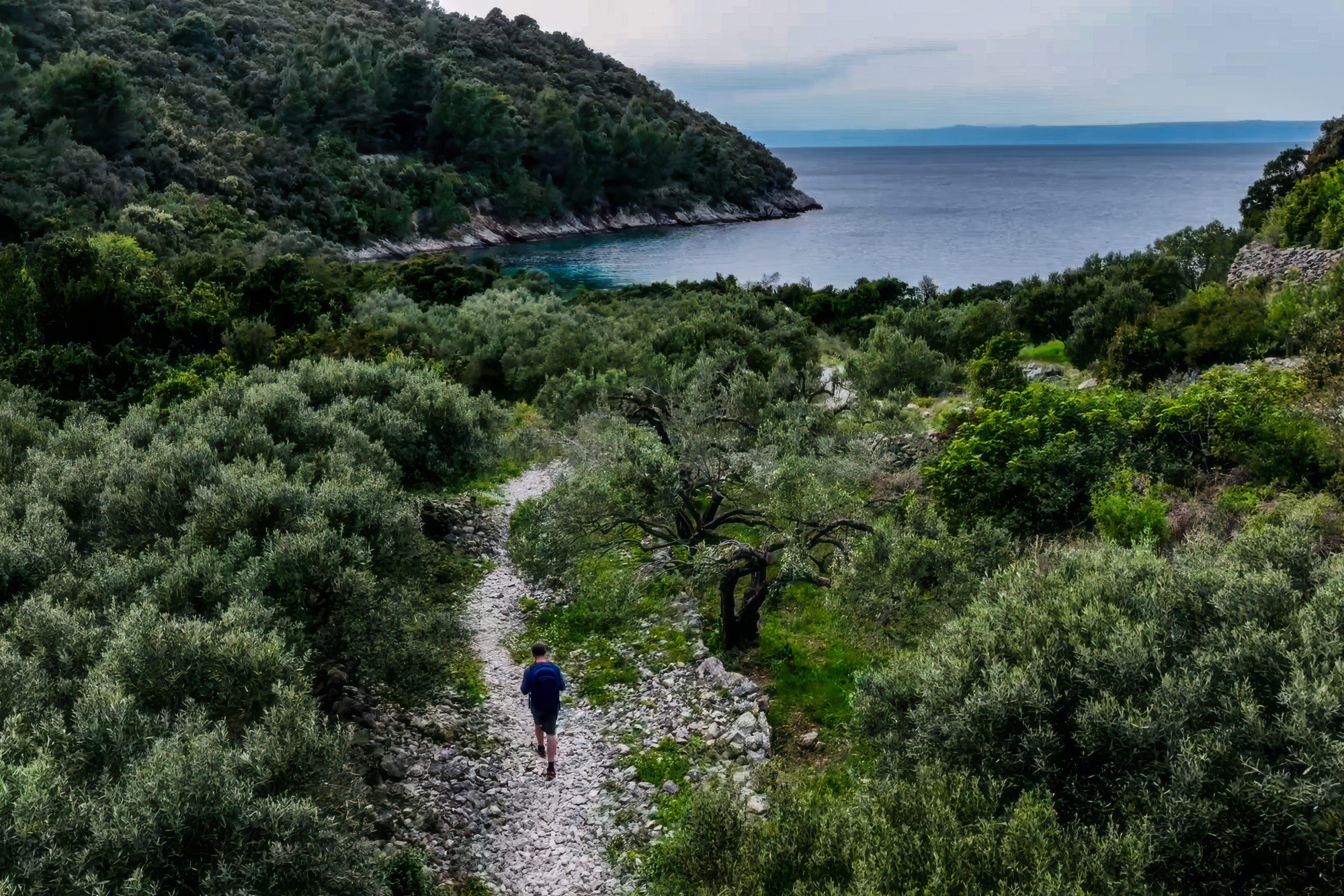
“This better be worth it,” my photographer friend Dave says, as we descend a long set of steps in search of a cove I’d discovered about three minutes earlier on Google Maps – a last-minute find to kill time before dinner. We emerge through a clearing in the trees, the sound of lapping water growing louder. Time for the reveal. We’re met, to my relief, with a Dalmatian paradise: a tucked-away bay with pine trees clinging to steep slopes, their branches almost touching the water below. At a small shed – a beach bar – overlooking the scene, our arrival interrupts the only three people here mid-conversation. They look surprised. One of them calls out to us in Croatian.
“Engleski,” I respond sheepishly.
He places his beer bottle on the table, pushes his chair back and walks towards us.
“We’re closed,” he says firmly.
Dave and I begin to swivel on our heels.
“But I can grab you a beer. We’re not used to seeing tourists out here away from the city – what brought you?”
After filling him in on our trip and the itinerary we’ve got lined up for the next few days, he asks what flight we’d arrived on. “I came over from Manchester,” Dave says.
“Oh, I was on that plane too,” he replies.
A pause.
“Actually… I was flying it.”
He grins and turns back towards his friends. “Well, you’ve picked a good place. Enjoy your trip – you’re going to love it here. Trust me.”
Into the great beyond
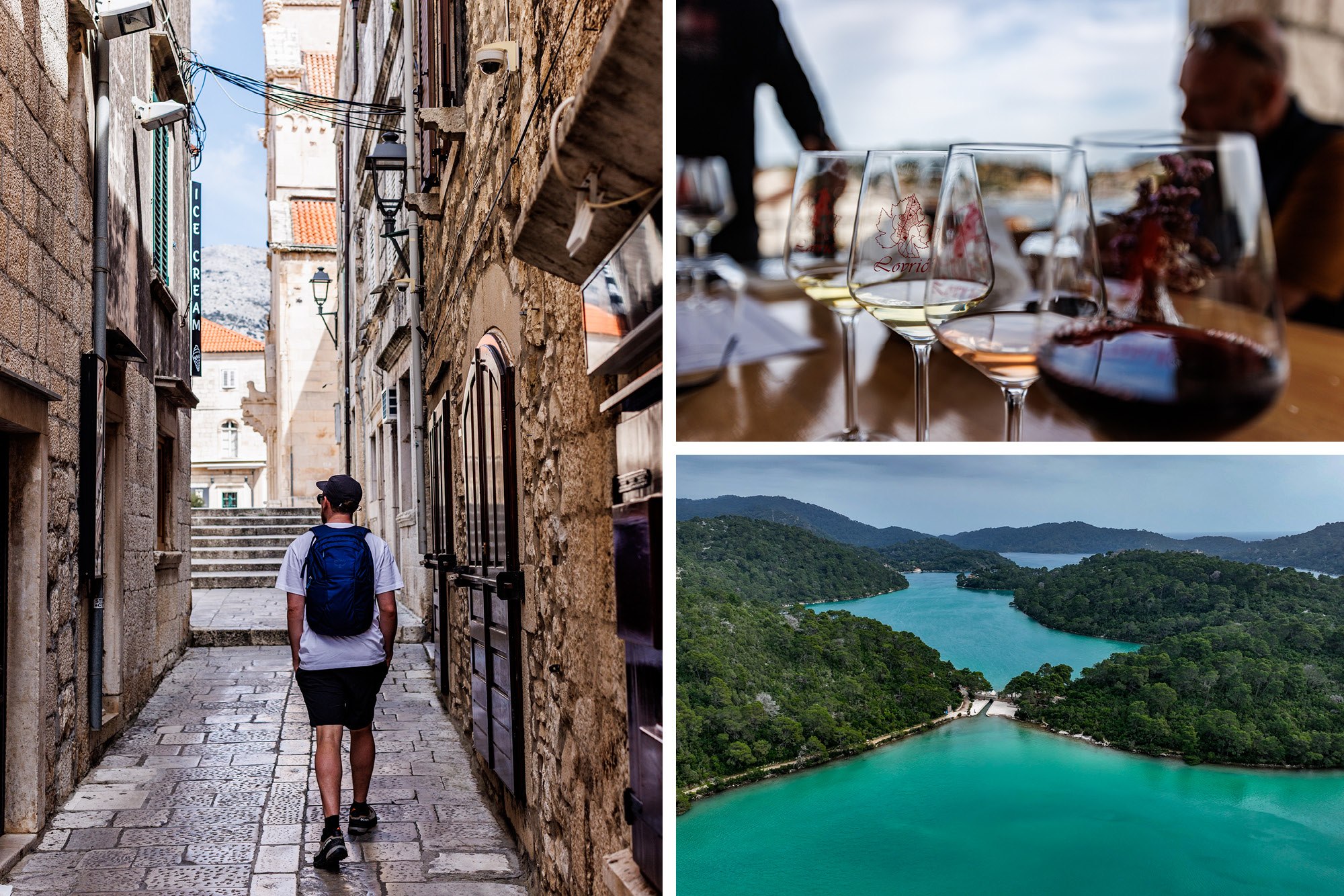
My flight the night before, which arrived from London, had been full of excitement. Destination: Dubrovnik. Groups off for a weekend of partying, families heading to the beach, and couples gearing up for a long weekend of sightseeing within the ancient city walls. But while the majority of my fellow travellers would be joining the millions of tourists who squeeze into the narrow streets of the famous Old Town every year, I was relieved that we’d be breaking away from the crowd, heading beyond the bounds of the city walls to explore the quiet peninsulas and islands that make up the Dubrovnik Riviera and wider Dalmatian coastline.
“Millions of tourists squeeze into Dubrovnik Old Town every year. We’d be taking a different path”
Our itinerary was carefully planned. We’d firstly be heading east to explore Konavle, a narrow municipality wedged between mountains, sea and the border with Montenegro. We were then going to skip past Dubrovnik for some island hopping. First, we’d be using the Pelješac Peninsula to reach Korčula, the 46km long, 8km wide island on the Dalmatian coast that’s famous for its wine. We’d then head to the slightly smaller and far less populated Mljet, an island filled with trees, lakes and inlets and where there’s a 50 square-kilometre national park – it’s a place known as the “green pearl of the Adriatic”.
It’s all Grk to me
I’m seated on a vine-shaded balcony belonging to a friendly elderly gentleman – we’ve just cycled here on a fantastic e-bike tour of the eastern end of Korčula island. Ahead of me are four glasses of wine: two whites, a red and a rosé. Beyond, I’m looking out onto a curved sandy bay backed by little houses with red-tiled roofs, while nearer to us is a small vineyard – the vineyard that produced the delicious wine I’m drinking.
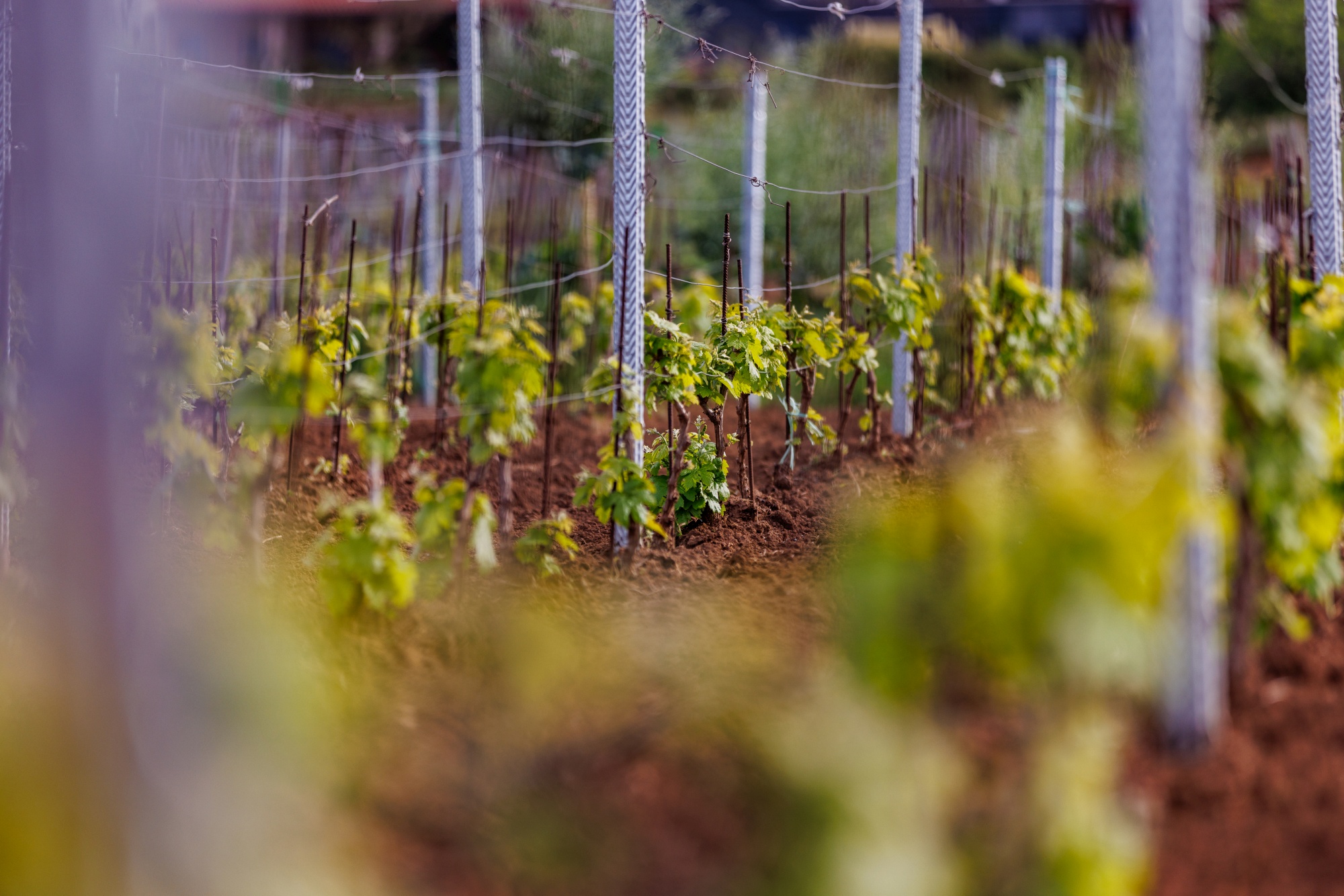
This is the Lovrić winery, one of many small-scale wine producers on the island. While they might only produce a fraction of what other wine regions might produce, Korčulan wines are highly regarded throughout Croatia. Their Grk wine, which comes, almost exclusively from the small section of the island known as Lumbarda, is remarkably unique – and not just in flavour. Unlike the vast majority of the world’s wine grapes, which can self-pollinate, Grk has only functioning female flowers, making it entirely dependent on neighbouring vines to survive.
“Grk vines only have female flowers, so must be planted next to other varieties to survive”
To produce fruit at all, it must be planted alongside a variety that blossoms at the same time – typically Plavac Mali, the bold red grape of the Dalmatian coast, or the white Pošip. Walk through a Grk vineyard and you’ll find them growing side by side, a centuries-old arrangement that hasn’t changed because, quite simply, it can’t. To add to this, I’m told by our host that the sea plays a key role. Here in the region of Lumbarda, the vineyards quite literally reach down to the beaches, the sea throwing light back onto the vines from below. The result is a wine of rare character: dry and aromatic, with hints of pine, saline minerality and citrus. Very little of it leaves the island – which, sitting on this balcony, feels entirely appropriate.
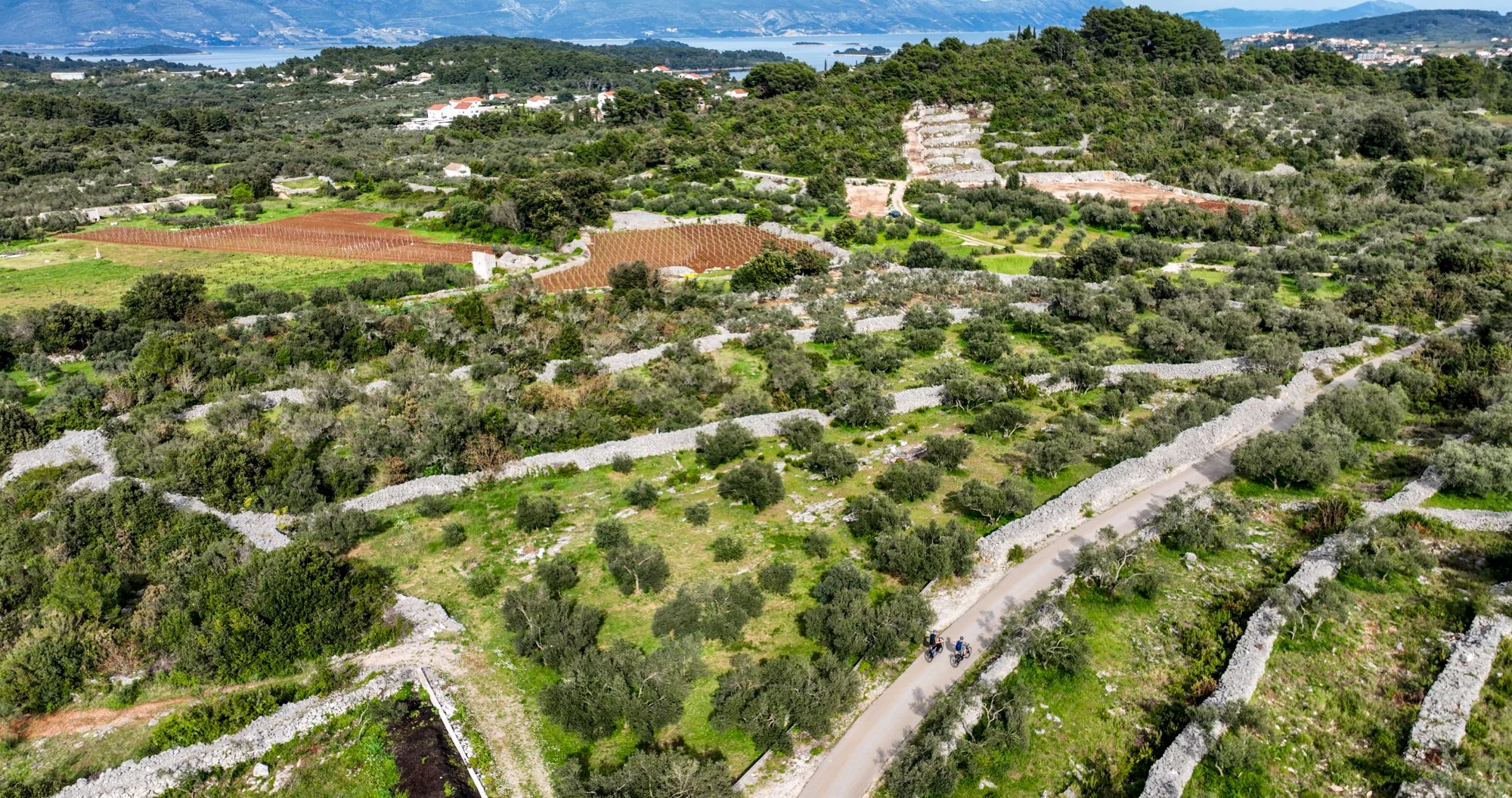
Grk wine, unsurprisingly, pairs perfectly with seafood, and this part of the world is very good in that arena too. Mussels and oysters are a specialty for this stretch of coastline, and Crni rižot (Black Risotto) a signature Dalmatian coast dish made with cuttlefish ink, rice, olive oil, garlic, and red wine, is ever present on the menus of the cafés and restaurants we encounter. They’re very proud of their olive oil here too. In fact, alongside the vineyards, just about every section of Korčula is occupied by ancient olive groves – some hundreds of years old.
“This is the best olive oil on the island,” a waiter at an unassuming cafe in Korčula Old Town tells us as he places a bottle at the centre of our table. I pour out a thimble’s worth and dip my finger in. It tastes remarkably fresh, but that taste is then immediately followed by a scratchy sensation at the back of the throat. Later, on a tour of a local honey, olive oil and gin producer called OPG Komparak, the owner explains to me that the scratchiness is in fact, a very good thing – a sign of high-quality olive oil.
Living in a hiker’s paradise
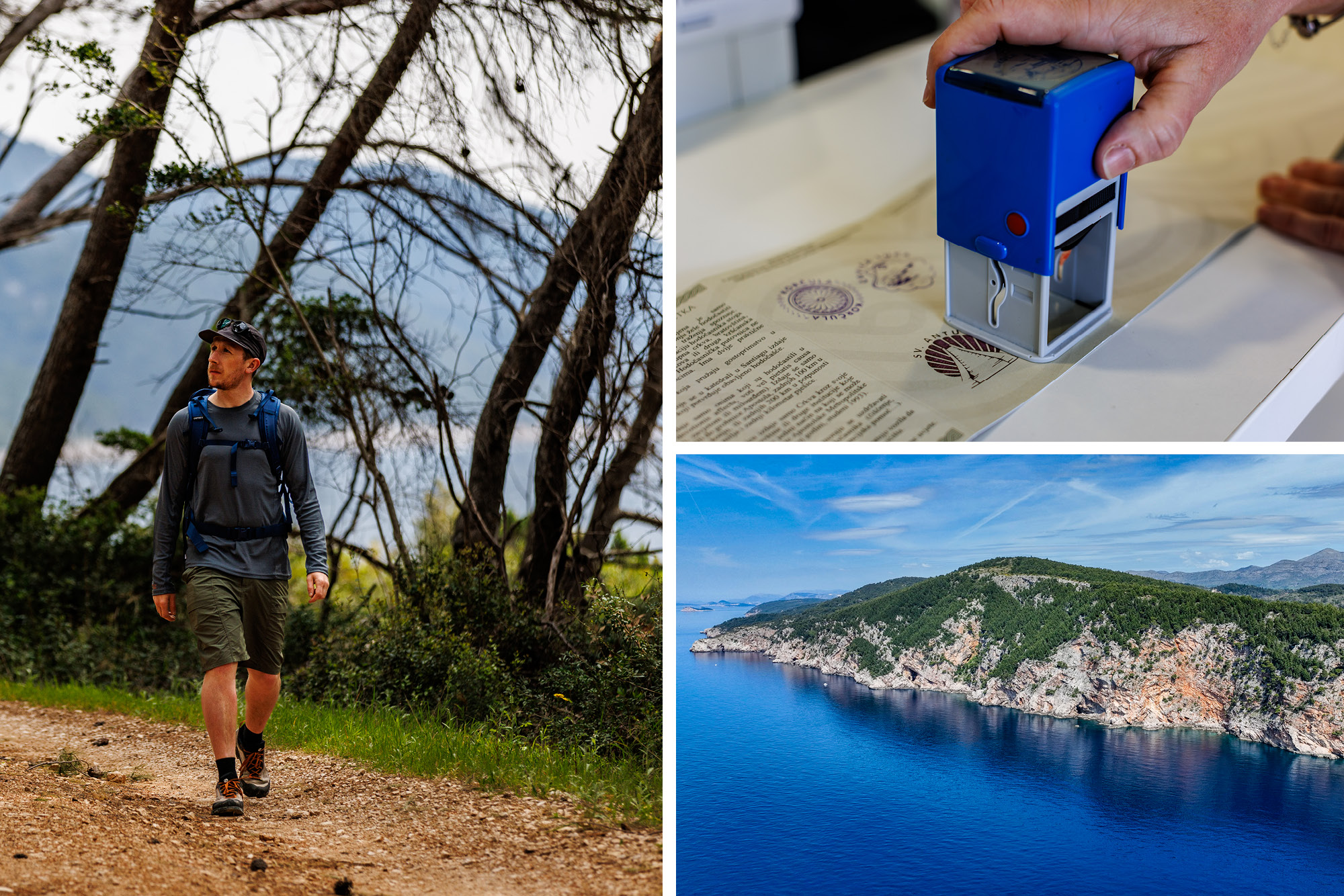
We’re in a quiet square in Korčula Old Town, a place often described as a ‘mini Dubrovnik’ – the same medieval stone walls, red-tiled roofs, and limestone architecture but in a much smaller, less crowded package. While we wait to meet our walking guide for the day, the calm is broken as a group of ten hikers rounds the corner, all loud voices, smiles and backslaps. They head into the tourism office as our guide, Milijana, steps out. “They’ve just finished the Camino Korčula,” she explains. “They’ve been hiking for the last eight days.” The rest of the day is spent exploring sections of this route ourselves. Founded only three years ago, it’s one of more than ten pilgrimage routes in Croatia, all linked to the Camino de Santiago – the Way of Saint James.
The 98-mile trail runs right around the perimeter of the island, its ‘prayer arrows’ guiding hikers through the olive and almond groves, thick pine forests and past the many coves and little wine-producing towns and villages scattered throughout the island. Just like on the Camino de Santiago, the ‘pilgrims’ carry a passport which can be stamped at the churches and chapels encountered along the way. The happy hikers we’d seen before had just had their last stamp at Korčula Cathedral and picked up their certificate to certify the completion of their journey.
We find more excellent walking after skipping over to Mljet via ferry. It’s an incredible sight to behold as you approach it, with its steep hills totally blanketed in green. Its mediterranean vegetation covers 70 percent of its surface, making it the most wooded island in the Adriatic and a haven for wild boars, fallow deer and even mongooses.
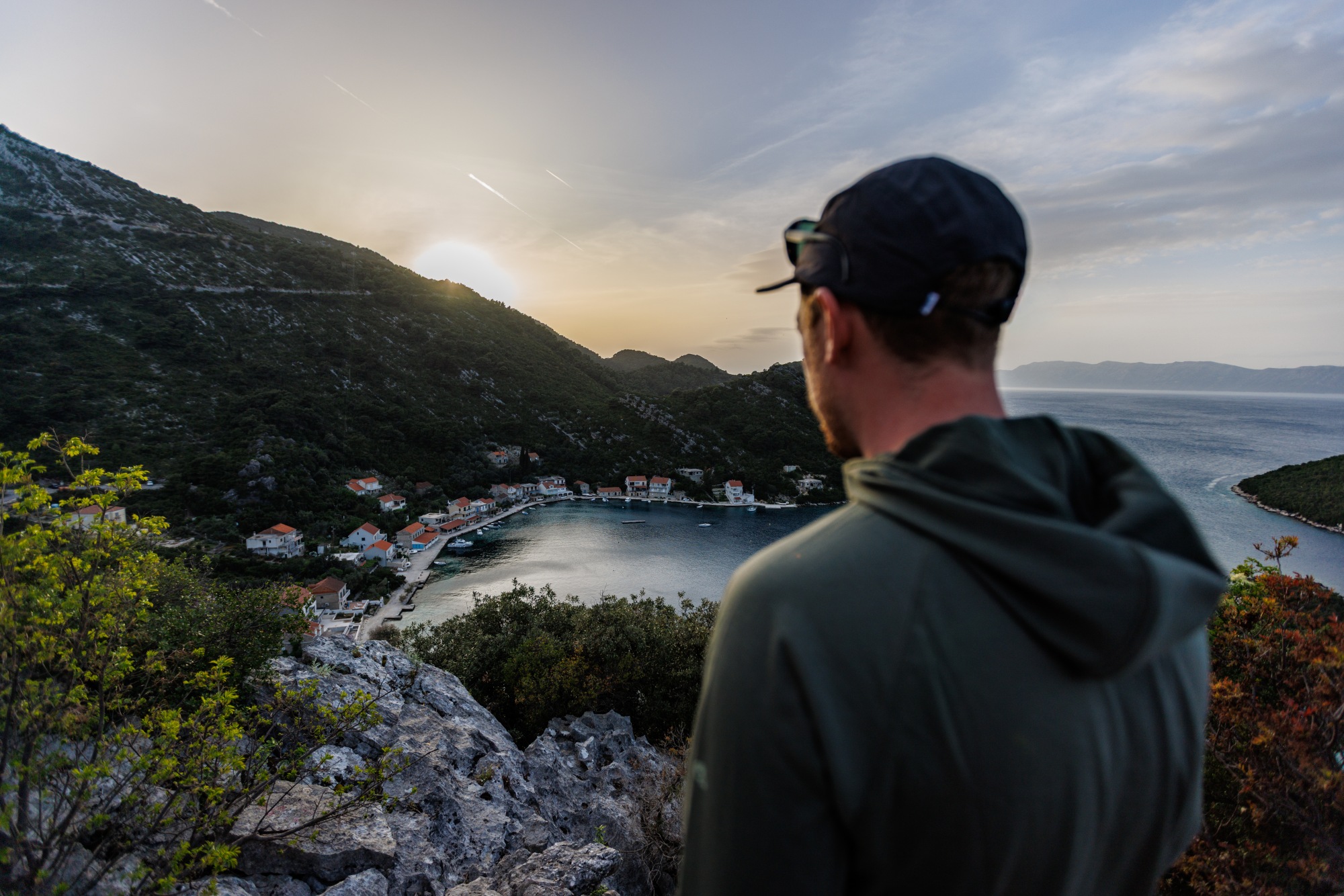
“There’s one,” Dave says, as he spots a small, furry animal darting across the road. We’re on our way over to Mljet National Park, in the western corner of the island. It’s a place that’s best viewed from the hike up to Montokuc where the 200m-height allows you to see the alluring lay of the land here; a place of inlets and islands, and two great lakes. These lakes are actually filled with saltwater, with channels of no more than a couple of metres in width linking them with the waters of the Adriatic. If it could be bottled up, I’d pay good money for the aroma here on this island. The smells from the saltwater, aleppo pine and the huge array of wild flowers, including 30 species of orchids that bloom here throughout spring, all combine to create a fresh scent like no other.
“Mljet has been a place of seculsion for centuries. It feels like we have the whole island to ourselves”
It’s a fine, sunny day, but it feels like we have this entire national park to ourselves. Actually, it feels like we have the whole of Mljet island to ourselves. This has been a place for seclusion going back centuries – a quality noticed by a group of Benedictine monks who set up a monastery here in the 12th Century. We take a 5-minute boat ride across to its island location to visit its small chapel and wander around the plant filled gardens surrounding it. It’s easy to see why the monks chose this spot – cut off from the world, with nothing but trees and light rippling across the jewel-like and mineral-rich water surrounding them.
Transitioning
At the end of the day, we board a ferry back to the Pelješac Peninsula, one of only a handful of passengers making the journey. This whole trip has, on reflection, had a totally unhurried, relaxed feeling to it. No crowds, a slow-pace, and a population who seem to take a laissez faire approach to life; a place where, as one of our guides pointed out to us, you can leave your house unlocked or bike on the side of the road without concern.
Arriving back to Dubrovnik airport the next day, the transition is jarring. The stillness we’d settled into is quickly replaced by queues, tannoy announcements and the restless energy of people coming and going. As the plane takes off, soaring over the network of roads, and roofs clustered around Dubrovnik, it’s the horizon full of long, green islands beyond that my eyes are drawn to. I wonder whether my pilot friend from our first evening is in the cockpit. I think how difficult it must be for him to drag himself away from a place like this on a daily basis - but also, about how lucky he is that every time he flies away, he always gets to come back.
Know how
Our trip
Will and Dave’s trip was supported by the Dubrovnik Riviera Tourist Board. Their website offers tips on what to see, where to go, and how to book.
Getting there
Airlines such as Easyjet, Ryanair, Jet2 and British Airways offer direct flights to Dubrovnik Airport from numerous cities.
Where to stay
They stayed at Hotel Astarea, near Dubrovnik Airport and at the Moro Inn on Korčula.
Where to Eat
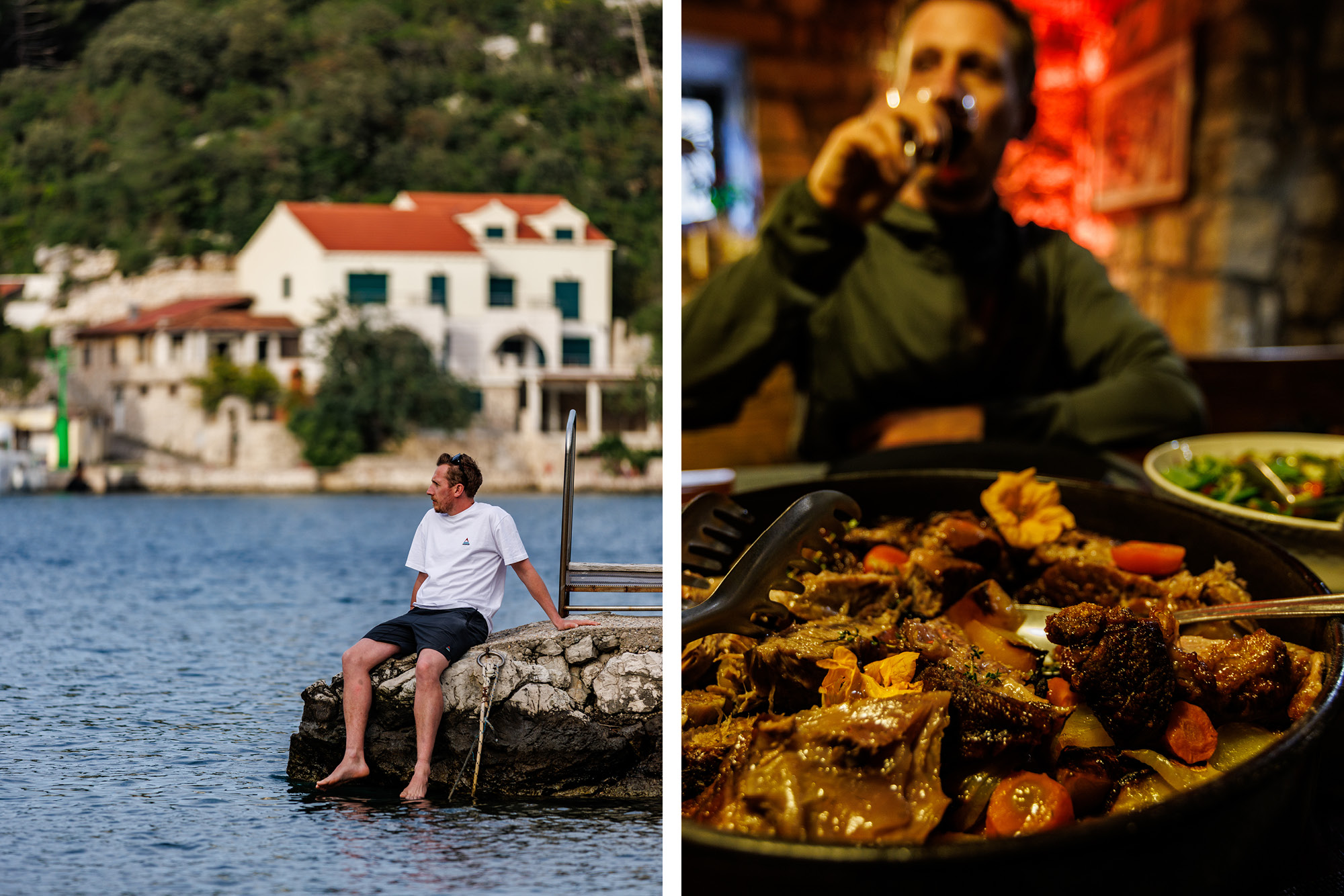
In Konavle, Will and Dave headed to Seoska Kuća to try their delicious meats slow-cooked for hours ‘under the bell’ – a traditional method called ispod peke. On Korčula, they enjoyed Konoba Adio Mare for its fresh sea food, excellent service and views over the cathedral. They headed to BotaSare on the Pelješac Peninsula for shellfish cooked using traditional recipes local to the area.
Activities
During their trip they sampled Korčula honeys and gins at OPK Komparak. The vineyard experience was provided by Lovrić winery. Kojan Koral provided an ATV tour along the Konavle coastline. The Korčula bike tour was hosted by Kaleta Travel Agency.