- Details
- Written by: Martin Bissig
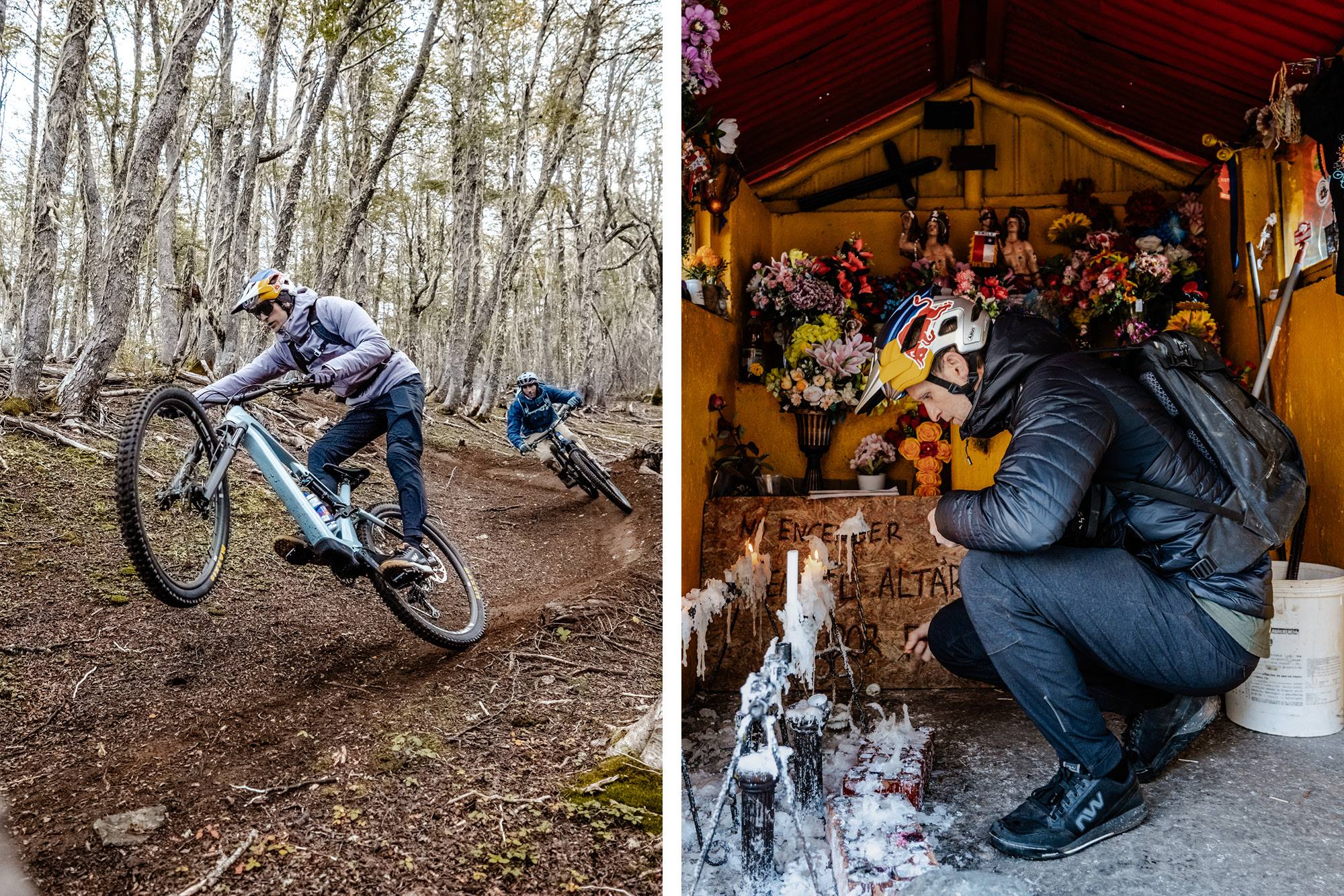
The needle of the 100-year-old gramophone crackles across the record grooves, and the scratchy sounds of tango blast from the big, HMV-style horn. Our host, Tito, is visibly proud of this heirloom from his grandfather—a memento of a time when the first settlers from Argentina tried their luck down here in the Central Patagonia. Tito is a gaucho: a Patagonian cowboy who looks like he’s been lifted straight out of a movie, with his leathery skin and hard muscles, wired tight from years of working with horses. Now 62, he’s clearly seen a lot in his life. But our high-tech electric mountain bikes are still a relative novelty. “Back in the day, we didn’t count in weeks or months, but in seasons.
“You guys, on your electric horses, look like you come from the future”
That’s how long it took to trade our farm produce up north for other goods,” he says. “But you guys, on your electric horses, look like you come straight from the future.” He points to the mountain behind his farm and a path starting right behind the house. “My ancestors came from there. Tomorrow after sunrise, we can go and take a look at the backdrop of my homeland from above, if you’re up for it?” It’s the kind of invitation we dreamed of, travelling here. Needless to say, we don’t need to be asked twice.
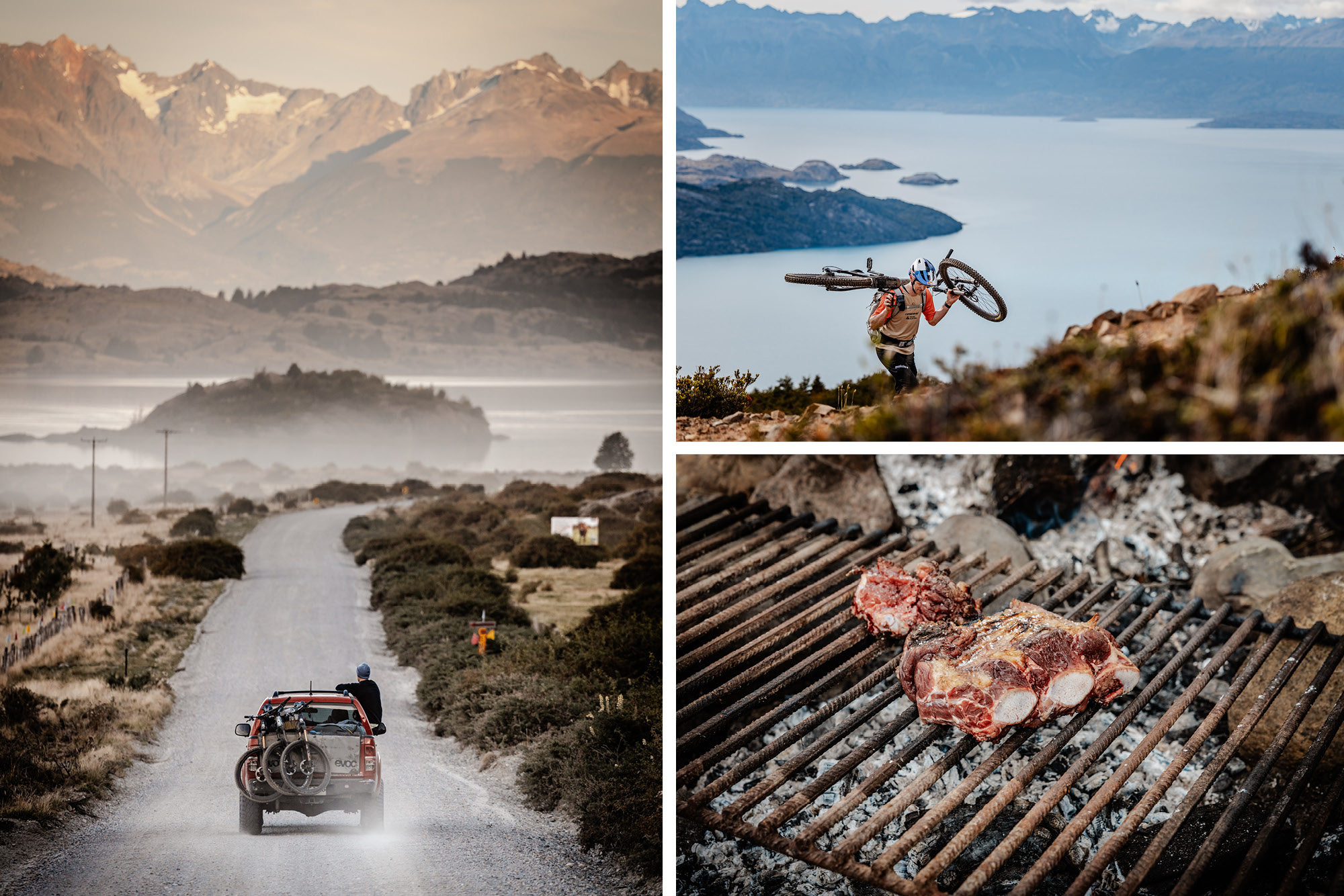
There are places in this world where your brain automatically conjures up specific images. Think ‘Patagonia,’ and the mind’s eye brings up pictures of snaggle-toothed peaks, deep blue lakes pooling in front of massive glaciers, and epic sunsets, of the kind immortalised by the eponymous clothing brand’s logo. But it’s not all like that. Patagonia is a vast area, which stretches over a million square kilometres across Chile and Argentina. It’s about three times the size of Germany, but has 40 times fewer inhabitants. It long been an absolute bucket-list destination for nature lovers, adventurers, and alpinists. But for mountain bikers, this part of South America is still pretty much a blank spot on the map. And the central part of the region, where we’re heading, is virtually unheard of.
This, is something that our guide Patricio Goycoolea (or Pato, as everyone calls him) is hoping to change. A native of Santiago de Chile, he tells us he left the big city behind during the first wave of Covid. A passionate mountain biker, guide, and mountaineer, he explains that he was really just waiting for an excuse to move, and the pandemic provided it. But he was careful—both for business and health reasons—to steer clear of the beaten tourist tracks.
“The tourist hotspots down here don’t interest me,” Pato explains. “Torres del Paine or El Chaltén: undoubtedly beautiful areas, but way too crowded for my taste. Plus, you’re only allowed to ride on wide gravel roads there, so that’s a no-go for me!” Instead, Pato settled with his wife and two small children in Villa Cerro Castillo in the middle of Patagonia. The Aysen region, which he now calls home, will be the starting point of our two-week long mountain bike adventure. “We” means Pato, my buddy and pro rider Tom Öhler, and me, trying to capture the whole trip in photos and videos. We ask Pato beforehand if there is anything to consider. “Bring warm clothes,” he writes on WhatsApp. “Here in Patagonia, you can experience four seasons in one day.”
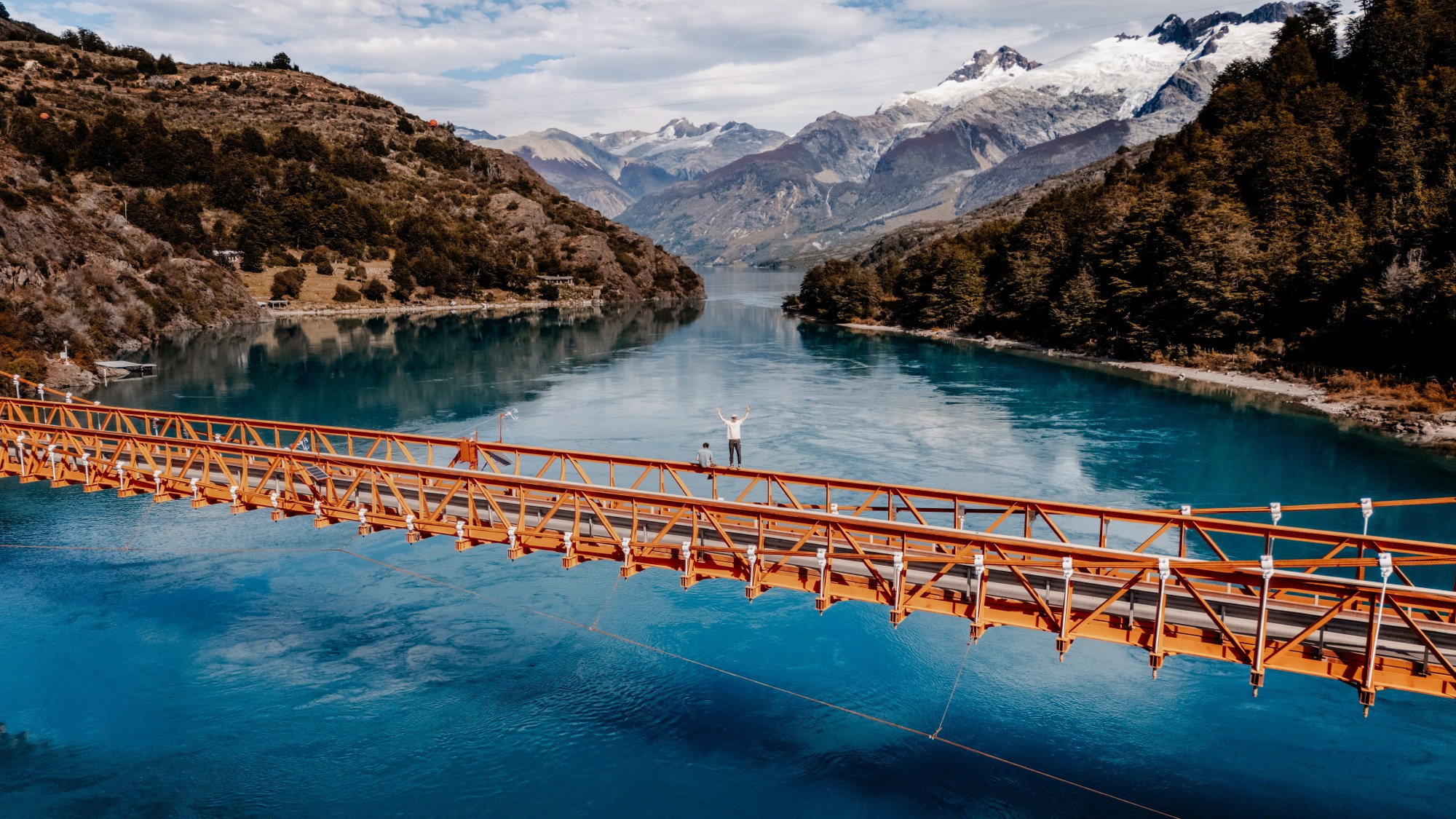
The Middle of the Middle of Nowhere
After a journey lasting almost 48 hours, we finally land in Balmaceda. The end of March is autumn in the Southern Hemisphere, so conditions will be perfect for biking, Pato assures us. Not too cold yet, but popping colors and insane light. Arriving in the Central Patagonian town of Coyhaique, we immediately notice that a lively bike community has formed here. There are several bike shops, and Pato raves about over a dozen marked and lovingly built trails on the mountain just behind the city. We quickly make a plan to hit the summit at sunrise.
When we reach it the following morning, the mountains are aglow with soft, orange-red light. Arriving at the hilltop radar station, we crack the door of Pato’s pickup just a tiny bit, and the fierce wind nearly rips it out of our fingers. It is freezing, feeling at least 10 degrees colder than down in the city. The view from up here is absolutely killer, but we don’t want to expose ourselves to the wind and cold for long. But Pato is feeling the stoke, jumping out of the truck and grabbing the bikes off the back. “Vamos hermanos,” he shouts, mashing the pedals as he sets off at a clip.
The trail snakes first over loose, gravelly terrain. The landscape, raw and bleak, somehow reminds me of Iceland. We paint wavy lines in the dirt like freeride skiers, drawing big turns. After a few hundred meters of vertical drop, we reach the treeline, and the scenery changes abruptly. There are trees—unlike Iceland—and they’re covered in lichen, indicating moist, high-quality air. Pato and Tom get into the flow and chase each other down the curvy trails. “Let’s do that again right now,” Tom shouts, also feeling the stoke, as we reach the outskirts of Coyhaique.
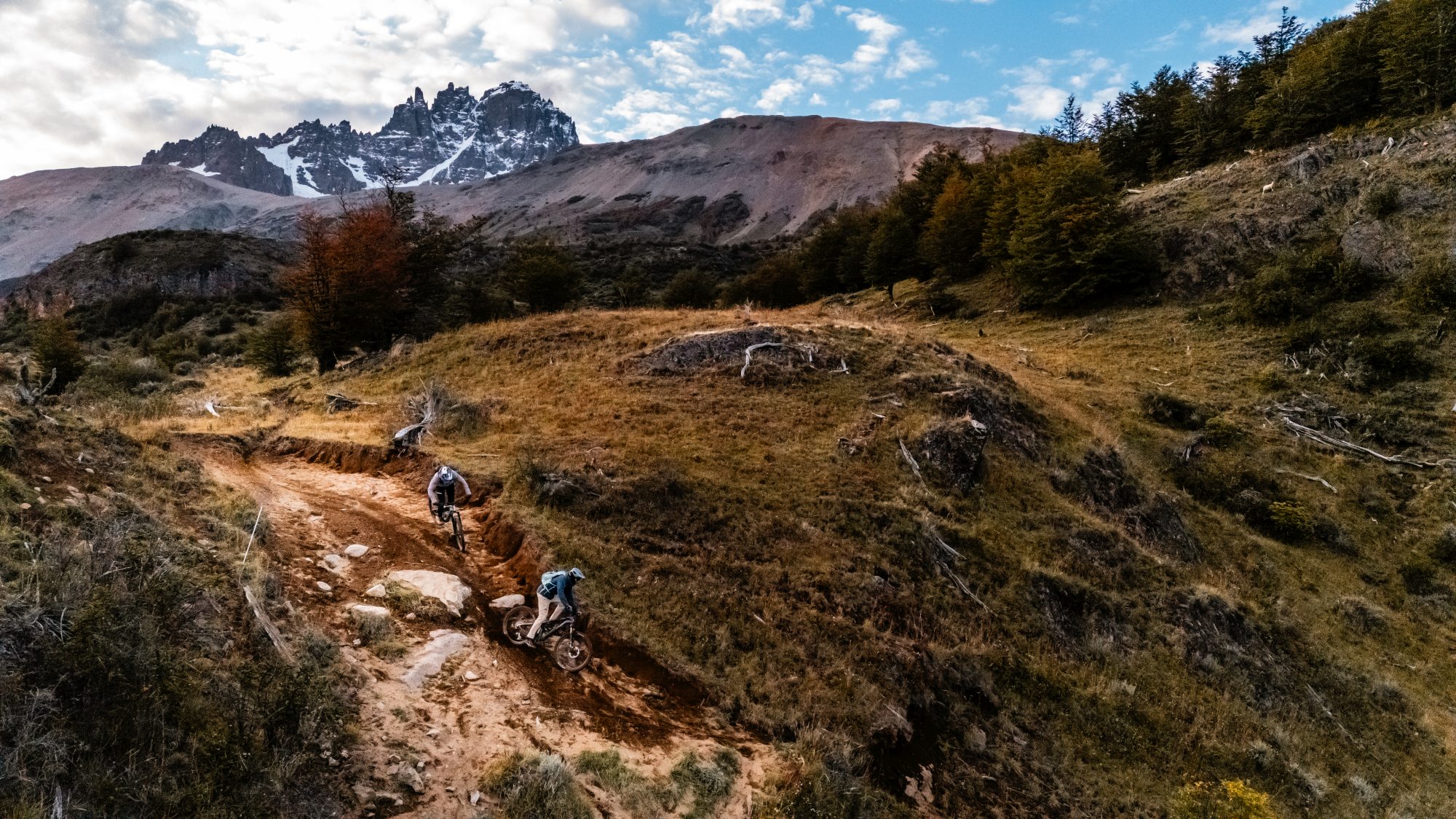
Back at the top, we decide on a different descent this time, dropping in over a massive gravel slope. After a few kilometers, we stand in front of a ski lift that has seen better days.
“Actually, the plan was to build a bike park with a lift shuttle here,” explains Pato. After the initial euphoria, they had to realize that, unlike ski resorts like Whistler, there are simply too few potential bikers here for such an offer. We don’t care. Thanks to Pato’s shuttle and our e-bikes, we get to the trails without much effort anyway. And after a day or two, it’s easy to see exactly why such a lively scene has developed in the area. It might not be Whistler, yet, but the natural ingredients are all here.
Pato’s home, a 90-minute drive north in Villa Cerro Castillo, is less well-known. Located at the foot of the striking 2,675-meter-high mountain of the same name, the village is home to just 400 people, including Pato and his family. There are a few cycle tourers passing through town, and a decent coffee shop in a converted bus. But no other mountain bikers for miles around.
Over the next few days, we ride various loops that Pato himself has pioneered. They’re flowy and well-maintained, and you can tell Pato puts in work here regularly. The views are also spectacular. “We can consider ourselves lucky,” he says on one excursion. “We don’t often have such a clear view of my local mountain.” Patagonia is not famous for its clement weather. But the forecast looks set fair, and Pato has a new trail he’s never ridden before that he wants us to try out.
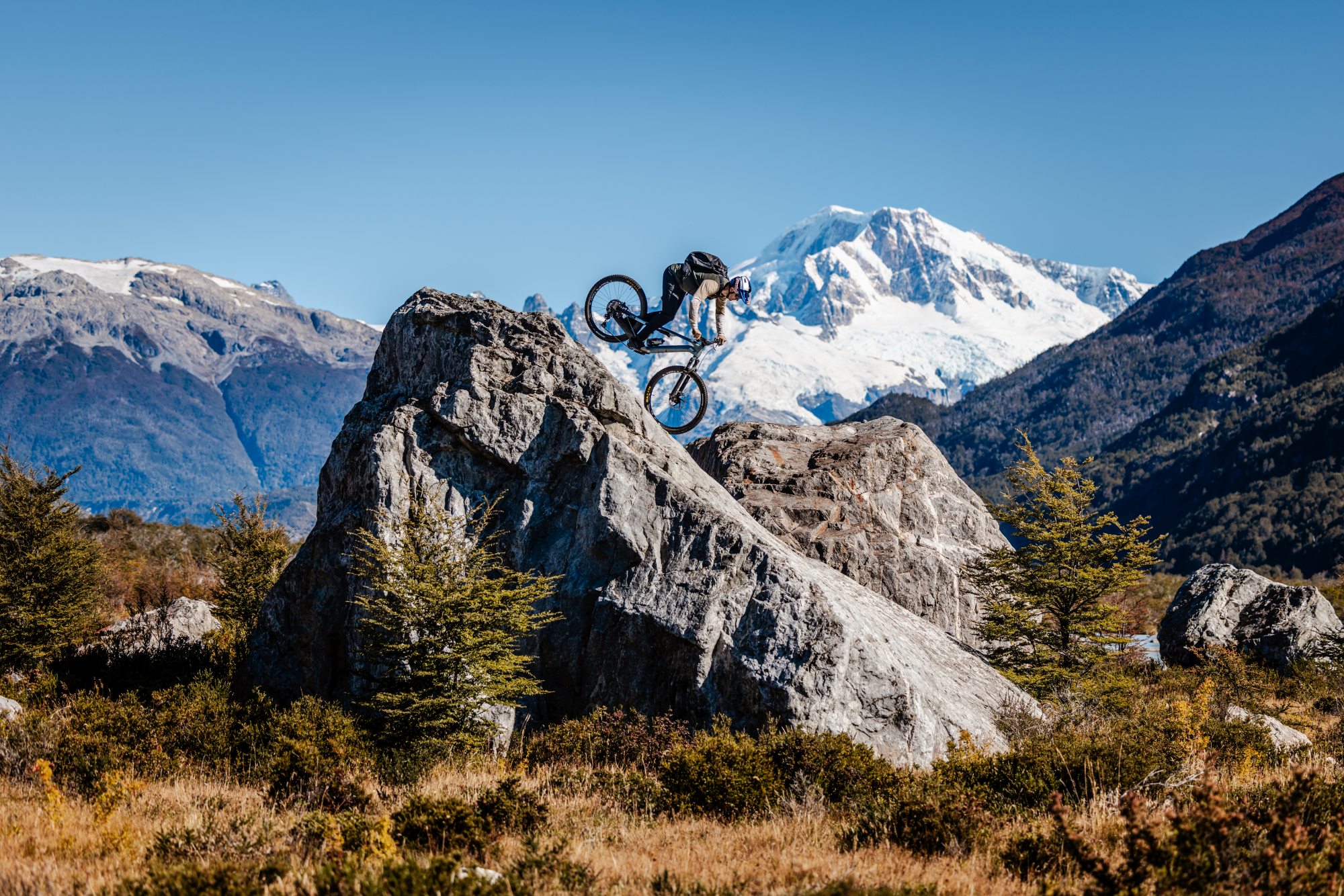
We reach the starting point of this mini-expedition after an hour’s drive. The first part of the route passes easily and quickly on wide logging roads thanks to our electric motor support. But then it gets more demanding. We stand in front of a massive wall of scree. A look at the map confirms my suspicion: we have to go up there. I decide to leave my bike and continue on foot, as I’m already lugging enough ballast around with my photo and video equipment, but Pato and Tom shoulder their bikes and off we go. What follows is a long two-hour hike-a-bike session up into alpine terrain. Luckily, I have my drone with enough batteries and so follow the other two from a fixed position for the last few hundred metres of elevation.
‘“That is freeride, Hermanos,’ shouts an enthusiastic Pato”
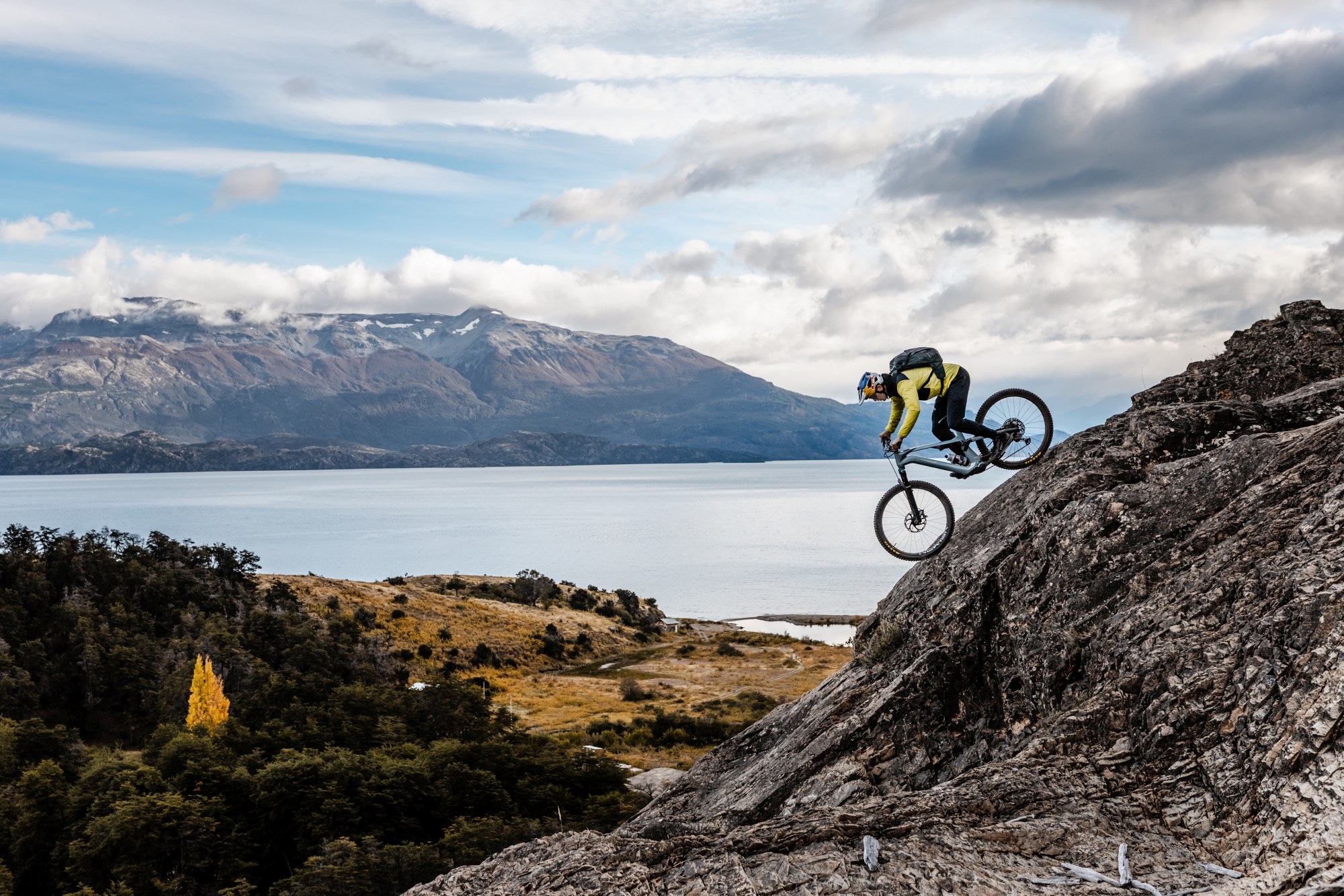
When they come down, however, whooping with joy and with huge grins on their faces, I almost wish I’d taken my bike too. “That is freeride, Hermanos,” shouts an enthusiastic Pato, as I follow them down and we head to a glacial lake. What’s even crazier than the terrain they’re riding—at least to my brain, hardwired as it is to the Alps—is that we’re only at about 1,100m above sea level. Huge glacier tongues protrude directly into the valley behind us, and there’s no vegetation far and wide. My intuition tells me: “we must be at 3,000 to 4,000 metres, easily.” But my body and breathing confirm the map data. “Now I know why there have probably never been bikers here before,” Tom says to Pato, laughing. You really have to actively search to find trails in this corner of Patagonia.
The End of the Road
Next on Pato’s magical mystery tour is a drive further south where, he says, “I know a secret spot or two.” After a few kilometers, the road surface changes, and the well-paved road gives way to a gravel track. “That’s it for asphalt from here on,” says Pato. “Except for a few metres through the villages, this gravel track stretches all the way to the very south of our continent.” We are glad we aren’t riding our bikes on it—the traffic is pretty intense, and a dust lung would be guaranteed. It is already evening when we arrive at Gaucho Tito’s place—our invite secured because Pato knows his son Eugenio, who is a passionate mountain biker himself.
“This gravel track runs right to the end of the continent”
Y Wladfa
The strange story of Patagonia’s Welsh colony.
It’s not just the rugged landscapes, the excellent mountain biking, and the ‘variable’ weather that makes Patagonia feel like Wales. Just north of where Tom, Pato, and Martin were riding, in the Argentinian region of Chubut, lies Y Wladfa (or “the colony”) once a semi-independent, Welsh-speaking state. It was established by Michael D. Jones, a patriotic preacher from Eryri (Snowdonia) who argued that Welsh-speakers needed to escape the corrupting influence of English. Spanish-speaking Argentina agreed to grant him and his followers land, and in 1865, he led 153 settlers across the Atlantic.
By the 1880s, there was a thriving Welsh-speaking population of around 4,000. The number of new arrivals dropped off after WWI, but the linguistic and cultural influence remained. In 1982, after the Falklands War, soldiers from the Welsh Guards were apparently astonished to find themselves addressed in fluent Welsh by one of their Argentinian captives. Today, thanks to joint government programs “Patagonian Welsh” is still spoken by an estimated 5,000 people in the area.
Pato, Eugenio, and Tom pass the time with a typical gaucho game: the ankle bone of a cow has to be thrown as close as possible to a target. “I used to be a master at this,” says Tito, chuckling as he prepares the fire where pieces of meat will soon be sizzling. At the crack of dawn the next morning, we head up into the hills in the direction indicated by Tito, with Eugenio as our guide. First, there’s 1,400 metres of pretty steep climbing with some carrying and pushing sections. Unless you’re a pro like Tom, who with motor support can manage most uphill sections by pedalling. It’s almost as impressive as what he can do on the downs.
We leave the treeline behind after almost 1,000 metres of climbing and are treated to an incredible view of Chile’s largest lake, a 2,000 square kilometre body of water which straddles the border. The vastness of Patagonia is even easier to grasp from up here. We lie down and take a break. Our batteries are down to 16 percent, and even with the plentiful use of boost mode to get us the last few vertical metres to the summit, our body batteries feel pretty drained too. It’s hard to believe that Tito’s ancestors traveled over these mountain ranges with all their belongings on horseback. But while they might have been better prepared, physically, for the way up, our wheels mean we absolutely fly on the way down.
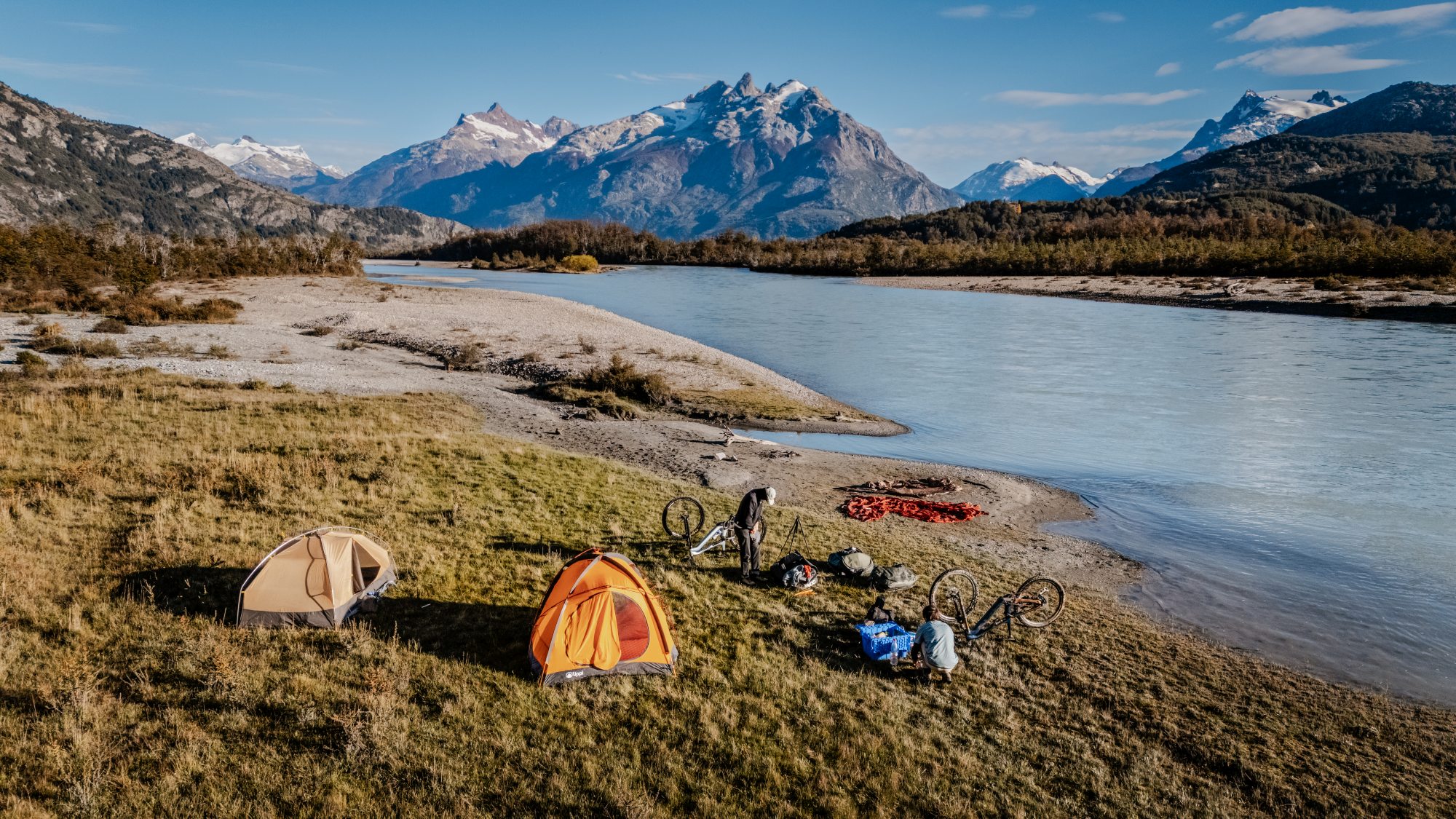
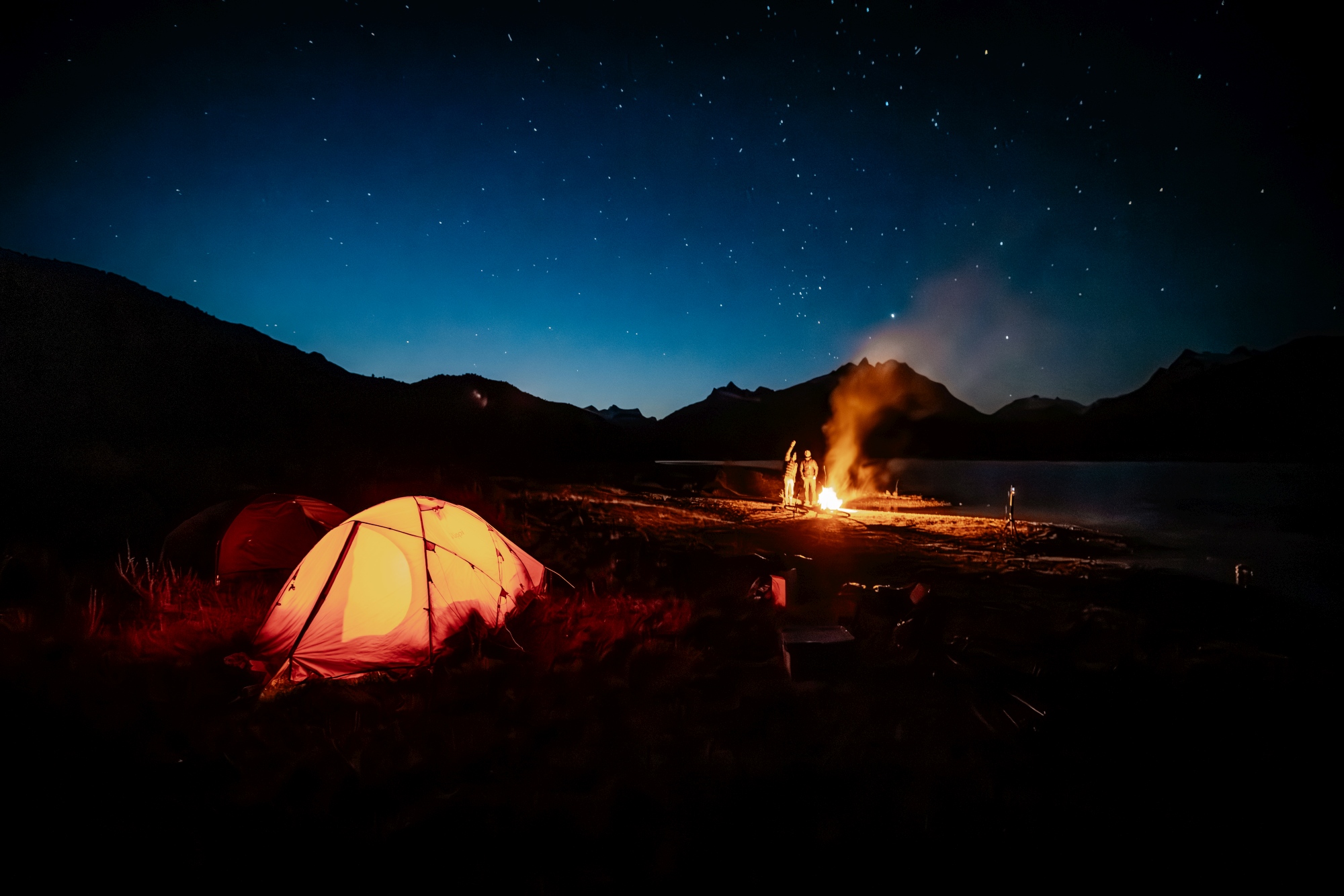
For our final night, Pato takes us camping—squeezing two tents in the bed of his pickup, alongside our three e-bikes and gear. Setting up camp by the river in Miraflores gives us a perfect view of the mountain range behind. Sitting round the fire, Pato tells us about his vision: “I want to make the region here a bike destination. You can see the potential.” We certainly can, and with his determination, it’s not hard to imagine it happening—even if he’s starting from a small base.
“At times, it feels like we have the whole of central Patagonia to ourselves”
We spend our final morning riding Pato’s patented trails around Puerto Guadal, a sleepy settlement in a range of hills full of minerals, fossilized prehistoric animals—and no other bikers. At times, it almost feels like we have the whole of Central Patagonia to ourselves. During a break Pato makes some calls and comes back with furrowed brow. “Hermanos, I have good news and bad news for you.”
The bad news first? The ferry from Chile Chico to Puerto Ingeniero is fully booked, he says, and we can’t get across with Pato’s truck. “Great,” I think. “That means eight hours back on the same road we came on.” So what’s the good news? “You have e-bikes,” says Pato. “Ride the 105-kilometer route to Chile Chico alone, take the ferry, and I’ll do the drive by myself and pick you up on the other side. There’s always room on the boat for bikers.” And so it is that Tom and I set off on a true Patagonian epic across this vast landscape.
Thankfully, it’s not a main road, and so we only meet about 20 cars en route. Even though these aren’t flowy singletracks, it is a really cool conclusion to our trip—helping to ram home just how empty this wilderness is.
After the two-hour ferry crossing, Pato picks us up on the other side of the lake in the evening. Despite not having seen any of the major tourist sites—or perhaps because of it—we feel like we’re leaving with a real sense of what Patagonia is all about. “The only thing we haven’t experienced is the famously bad weather,” I say. But I’ve spoken too soon. After 12 days of excellent conditions, it starts bucketing down on the way to the airport. “The sky is weeping,” Pato jokes. And as we board our plane to leave, we are a little bit too.
Know how
Getting there
Balmaceda, Martin and Tom’s starting point in Chile, has an airport with pretty regular connections to the capital, Santiago. You can fly from Heathrow to Balmaceda with two stops (in Madrid and Santiago) on British Airways and LATAM for £1,700 return.
Guides & Bookings
Patricio Goycoolea (aka Pato) is the owner and co-founder of Inner Mountain, which organises tailor-made trips to Chile—not just for mountain bikers, but for climbers, kayakers and other adventure lovers too. Their website contains contact details and prices.