
- Details
- Written by: Tristan Kennedy
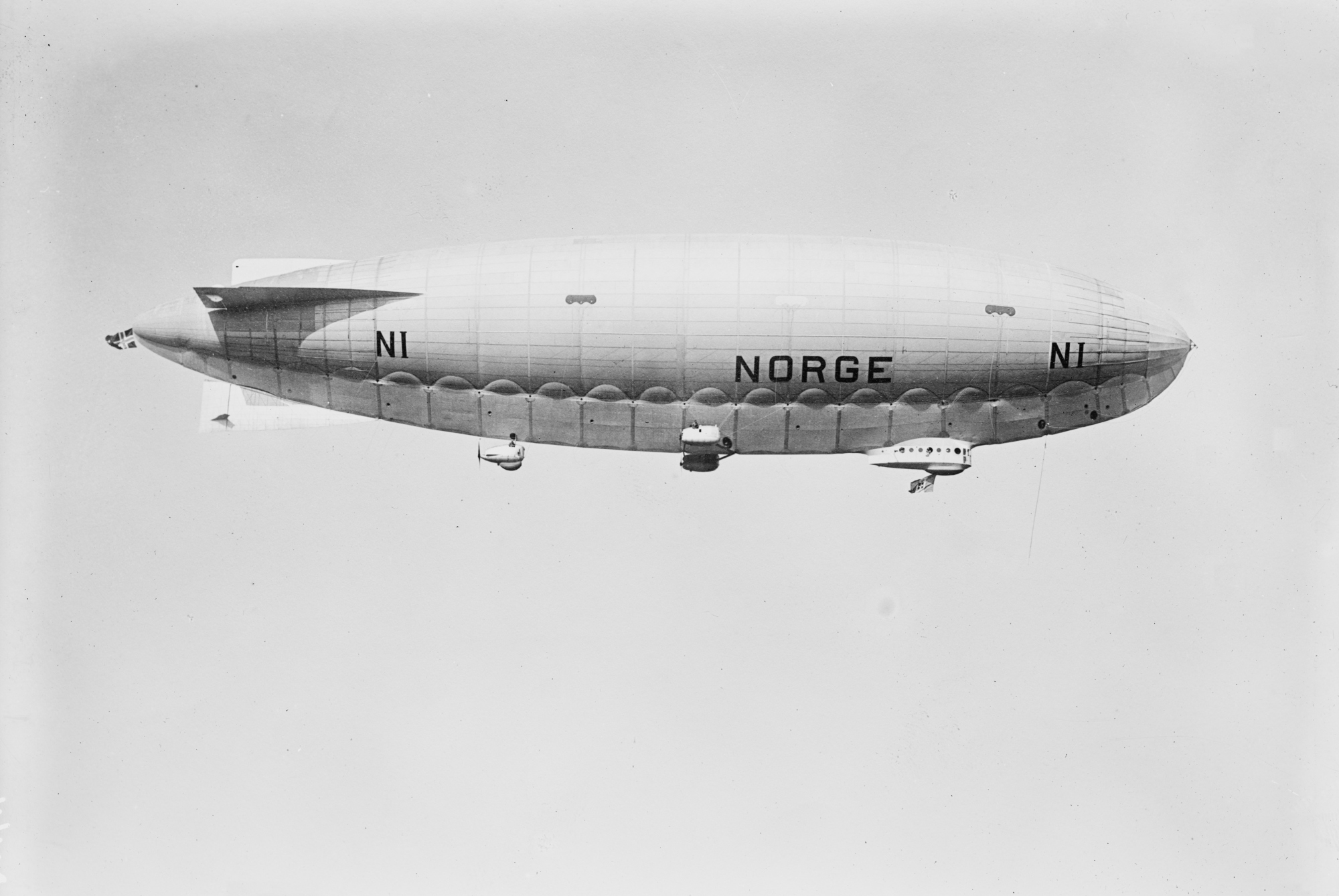
Is it a bird? Is it a plane? No, the first craft of any kind to make a verified trip to the North Pole was the Norge, a gigantic, 106-metre long airship, which sailed sedately over the Earth’s northernmost point exactly 100 years ago, on May 12, 1926. Designed by the brilliant Italian aeronautical engineer, Umberto Nobile, and built in 1923, the Norge—originally called the N-1—had an inauspicious start. On April 15th 1924, the hydrogen-filled balloon was moored at Campiano Aerodrome when it was caught by a strong gust of wind. A mechanic and two soldiers heroically tried to hold onto the mooring lines, but were carried 90 metres into the air and fell to their deaths.
At the time, however, air travel of any kind was dangerous, and despite such accidents, airships were considered by many to be safer and more efficient than airplanes—especially for longer journeys. One of those who was most interested in the technology was the Norwegian polar explorer Roald Amundsen. By 1925, he was already a legend, having sailed the Northwest Passage in 1903, and beaten Britain’s Captain Scott to the South Pole in 1911.
Convinced that aircraft offered the best chance of reaching the North Pole, he’d launched an attempt to fly there in 1923 using two Dornier Flying Boats. Unfortunately, one of the planes suffered a mechanical failure, and so they both made forced landings. The crews spent 30 days on the ice before they finally managed to escape in the working plane.
Undeterred, Amundsen decided to try an alternative means of flight, and after meeting Umberto Nobile in Oslo, he secured the funds from the Norwegian Aviation Society to recommission the N-1 as the Norge (or “Norway” in English) and fly her to the North Pole.
Starting from Rome, they flew to an airship station in Pulham, England, and then to Leningrad, in Soviet Russia, via Oslo. The final leg took them across the Barents Sea to the tiny settlement of Ny-Alesund, in the Svalbard archipelago. There, they met Richard Evelyn Byrd, a pilot who was determined to succeed where Amundsen had failed, and fly his airplane—a three engined Fokker—over the pole. If the great Norwegian was dismayed, he didn’t show it. And when Byrd returned after less than 16 hours claiming to have overflown the pole, he was among the first to congratulate him. Two days later, on 11th May, the Norge unmoored from the mast on Svalbard, and set off for its own attempt.
Onboard were 16 crew men, including five Italian mechanics, several Norwegian navigators, a journalist, a wealthy American named Lincoln Ellsworth who helped bankroll the trip, Amundsen, Nobile, and Nobile’s ever-present dog, Titina, who came along as a mascot. These magnificent men and their flying machine set off from Ny-Alesund at 9.55AM on 11th May, and fifteen-and-a-half hours later, at 1.25AM on the 12th, they reached the pole. Two days after that, despite having ice on its propellers and several rips in its fabric, the Norge sailed serenely into the Alaskan village of Teller, where it moored up for safety on the 14th.
Their total journey time of more than four days would of course be unthinkable for an airplane, even today. For many, Nobile included, this showed clearly that airships were the aircraft of the future. This idea was further reinforced when suspicions began to emerge as to whether Byrd had made it to the pole after all. His timings didn’t appear to add up. Like Frederick Cook, who fraudulently claimed to have reached the pole on foot in 1908, and Robert Peary, who said the same thing in 1909, most experts now doubt the veracity of Byrd’s claim—meaning Nobile, Amundsen and co. were the first people ever to reach the top of the world.
Unfortunately their lengthy voyage also created plenty of opportunities for tensions to develop. Despite (or perhaps because of) their success, Amundsen and Nobile subsequently fell out over who deserved most credit. But if their historic journey ended in rancour, there was a redemptive postscript. Two years later, Nobile set sail on another enormous airship called the Italia, aiming to repeat the feat. Once again, he reached the pole, but the airship crashed on the ice at it returned to Svalbard. An international rescue effort was launched and among the first to respond to the call was Amundsen, a grizzled polar veteran, and arguably the best-qualified person in the world for the job.
Nobile and five of his companions were eventually rescued—a saga immortalised in the Sean Connery film The Red Tent. But it wasn’t Amundsen who found them. Tragically, the great Norwegian was killed when the plane he was using for the search disappeared somewhere over the Barents Sea. While bits of the plane eventually washed up in Norway, his body was never found. In the subsequent decades, of course, airplanes became safer and more reliable, eventually taking over the skies—while airships, after several more high-profile disasters (including the famous Hindenburg fire) were consigned to the dustbin of history. But for a brief period, these slow-moving, stately craft set the pace of polar exploration—opening up the frozen ends of the Earth to the brave pioneers who piloted them.